Wednesday, May 13, 2015

For Better or For Worse: The Gambia's Top 5 Cultural Tidbits Spring 2015

5) I’ve Got My Eye On You

When I first arrived to Sare Ngai, I went on a daily jog up to the nearby village of Fulabantang.  Aside from a few cows, the occasional donkey, and the super- rare following of children, reminiscent of that scene from Forrest Gump, I was alone.  But afterwards, I’d tuck into a small building to do some exercises before heading home, and it was here where I attracted the unwanted notice of the village youths.  They would stop and stare; regardless of how hard I attempted to shoo them away, they remained steadfast in their attentions.  My frustration was palpable. Seeing this, one evening my host father sat me down and explained the curiosity of these peeping children.  He said, “Fatoumata, most of these children have never seen a white lady. Now here you come along, and you just start running.  But Fatoumata—you are not going anywhere.  Just only running.  They cannot understand this.  Then, you are squatting up and down, up and down.  They think—look at this white lady! Is it that she cannot decide to sit down or stand up?  Why is she doing that?”  I couldn't help but laugh at his way with words, and it made me put my anger into perspective, but it still didn't make me dislike being watched any less. 
So now, months later, I've adapted my routine and created a backyard gym of sorts.  I blew up a stability ball, made barbells and hand weights out of metal rods and giant tin cans filled with cement, and threw down a yoga mat.  Voila!  I could finally have the privacy I’d been craving.  But then, a few weeks ago, I was minding my own business doing some sit-ups, when I noticed something strange in my cement wall.  I took a second glance and realized there was a tiny eyeball rolling around in one of the blocks.  I yelled “Hey!” and the eye grew large and then disappeared as the young boy it was attached to ran away.  I was, as an American, as Meghan, absolutely furious.  My privacy had been completely violated.  I was being watched in my own bathroom where not only do I exercise, but I bathe, do naked dishes, and even sleep once in a while!  How long has this been going on?  These kids are going to get it! But then, remembering my host father’s words, I tried to imagine seeing a strange alien-person lifting up heavy things, setting them down again, jumping around erratically in her underwear and tennis shoes and how, as a child, it would be almost impossible not to spy on such bizarre behavior.  So I took a deep breath, filled an empty can with a bit of water and cement, walked outside, and proceeded to fill in the holes.  I soon had a gathering of kids around me, so I explained that it was not nice to watch people in their houses.  They helped me paste up the peep holes with their little fingers, and it became a fun “find the crack” game rather than the emotional display of outrage that the former Meghan would have insisted upon.  This experience showed me that it’s definitely not just us Peace Corps volunteers making a difference in some other country—the country and its culture are making a huge difference in us.  My patience and ability to see the other side of a situation has expanded to a degree I never thought possible for a hot-head like myself.  Now, if they could just work on my road rage….

4) Maternity Warden

As I mentioned a while back, my host mother, Hawa, recently had a baby.  She was born on March 23rd, is an adorable, healthy little girl, and upon the family first consulting me, was named after my own mother, Deanna Scripture.  It was such a touching way to honor my presence in the Kandeh family, and although my host father also gave her the traditional name, Isa, she is called Deanna by most of the village, which has been a real trip.  It’s particularly funny when, upon hearing her cry, people tell me, “Fatoumata, go pick up your mother—she is very upset!”
I have not had a child of my own, so this was the first time in my memory where I've witnessed the initial bonding of mother and child.  In Muslim culture, a woman is not to leave her home whatsoever for seven days following the birth.  With no electricity, Law & Order marathons are out of the question, so to keep mom and baby entertained during this first week, many visitors drop by and help curb the boredom.  I sat on Hawa’s bed, taking turns holding the tiny bundle in my arms, bringing her my lantern at night, and making simple conversation.  I watched as she struggled to feed baby Deanna before her milk came in, and as her brothers are sisters stared into the face of their new sibling for the first time. 

The night after she gave birth, in the still darkness of her room, three women came in carrying a towel, a large bowl of water, and some sticks with thick green leaves.  I shuffled a bit thinking I should go, but with a nod from Hawa, I was handed the baby and told to sit down.  So there, in the flickering candlelight, I sat and observed.  Hawa was placed face-down on the ground.  One woman rolled the leaves into packets tied together with twine from the branches and submerged them beneath the hot water.  Another woman took these packets and rolled them over Hawa’s back, letting the herbs and water run over her skin.  It filled the room with a heavy, Earthy scent and I could tell from the look on her face that Hawa felt relief. 
Never before have I felt like such a part of the community here, of my own family, as I did that night.  This was a private moment, that only a few women closest to my mother—not the younger girls, not even my sister—were invited to witness, and I was permitted to stay.  That night will stand as a powerful memory for me, not only as a reminder of my bond with Hawa, but of the deep bond that exists between women, across all cultures, and throughout all time. 

3) The Backway

It is not new information that many people from 3rd world countries, lacking the right passport, the right education, and the right amount of money to secure a visa to the West, look for a way, anyway, to reach the riches and opportunities they believe await them in Europe or America.  However, one year ago, if someone had asked me if I was familiar with The Backway, I would have blushed, given them a dirty look, and immediately walked away.  Now, I am rushed with desperate feelings of anger and sadness, as I've learned what The Backway really is—a long and dangerous journey synonymous with struggle and death. 
For some time now, Libyan refugees escaping the political unrest in their country have been granted asylum in Italy.  Other West African countries were quick to catch onto this, and began making the journey up to Libya in hopes of reaching the so-called Promised Land, where nothing but wealth and power await them.  People gather up all the money they can, often pay to secure fake documents, IDs, bank statements, etc. and head off for their better life. 
From Gambia, the journey is long, taking roads to Senegal, on to Mali, Niger, and then finally crossing into Libya.  Once there, it could be months or years before they land a seat on a ship.  As this route gains popularity, corrupt government officials, common thieves, and others looking for capital gain take advantage of these desperate travelers.  They bribe them, rob them at gun point, and hold them in prison camps under unspeakable conditions until they get what they need.  Families are called, money is wired—money that most are in no position to lose—and it turns to fate whether they are robbed again, or are able to move forward on their journey.
Many NGOs work to educate about and warn against using this method of leaving the country, but unfortunately, it just doesn't deter people, specifically young men, from trying.  Recently, over 400 people perished when their ship overturned and sank; but even knowing this, and of the miserable conditions on the ships which include having little food, no bathrooms, and even little to no drinkable water, people still want to go.  The desperation is truly blinding. 
It is the few that do make it over that give hope to the rest, though it is often those people who have it worst of all.  For us, it’s not hard to imagine why these men cannot find work. They have no papers, no formal education, and no local language.  The change in climate, culture and currency form a Trifecta of challenge nearly impossible to overcome.  Many live in make-shift camps on the outskirts of farms, hoping for a bit of work to feed themselves and to send money home to their families in Africa.  After all…they were supposed to be rich now…they made it. 
As time passes, the death toll continues to climb and with it, the number of homeless West Africans living in Europe.  The situation is attracting attention from the UN, who recently stopped the migration of nearly 1,100 Sub-Saharan's and deported them back home.  While I do what I can here to spread the news about the realities that await these boys if they try to go The Backway, I cannot make a measurable difference on my own.  Not a week goes by where someone in my village doesn't either know of a person who has recently died, talk to a friend on their way, or is trying to escape themselves.  These numbers are mind-blowing, and I can only hope that as time passes, the myth will be broken, and things will begin to change. 


2) Special Delivery

Vastly differing from most places in the developed world, rural, “up-country” Gambia is a sprawling land with a single paved road running through it, one above and one below the river that divides it.  One village stretches out behind the next, each cluster of huts connected through a maze of unmarked tributaries created from rough, rocky earth.  A community is found by its relation to another, not by its geographic coordinates or place on a map.  While this sounds lovely, you can imagine how the prospect of mailing something might present…a bit of a challenge.  Or so one would think...
However, combining the small size of this country with the large hearts of its people, somehow they make it work.  I've written letters for my school and asked what address to use.  I was answered with a strange look and, “just the name of the person and the village”.  Ok.  Then, last month, one of the Peace Corps drivers, John, who is a Christian-Gambian, was preparing for Easter and was on the hunt for a fruit called Baobab, which is dried and pounded up to make juice.  Apparently, my village is well-known for its abundance of Baobab, so this man phone my father and together, they commissioned a few boys to climb the trees, collect the fruits and arrange delivery to the big city.  I was in awe.  The entire transaction occurred between people who had never even met!  But sure enough, when I asked John if he received his fruits in time for Easter, he assured me he did. 
Although I was getting familiar with this mysterious postal service, I had still never taken advantage of it myself.  That is…until last week.  After spending the night in nearby Janjanburreh, a friend and I woke the next morning, did a bit of shopping at the market, and hopped on a bus.  When my stop came, I rushed out, waved goodbye, and walked off.  It was then I realized I’d forgotten my bag on the floor of the bus.  My precious mangoes! Why? Why! It then occurred to me that this was my chance.  So, I made a call.  I told my friend to give the bag to a driver heading back up-country.  “Tell them to give it to one of the policemen that stand on the road in Fulabantang.  Tell them it’s for the white lady in Sare Ngai.”

Within one hour, I had my mangoes, and they.were.delicious.


1) E-I-E-I…No.

These past months I've had a few close calls with some members of the animal kingdom.  For those of you who don’t know, there are very few things that make me as uncomfortable as random animals.  They are unpredictable, have no sense of personal space, and their bathroom habits need serious work.  That said, I do enjoy the beauty and grace possessed by some of Earth’s creatures.  Baboons, for example, have been out in full-force lately, and I appreciate seeing them scatter en mass across the road, and I even enjoy seeing the one brutish male who often sits high in the tree near my school (although when I pass, I sing to myself just stay up there, don’t mind me).  I've also gradually become accustomed to being constantly surrounded by goats, cows, donkeys, chicken, and sheep (although enjoy is not exactly how I’d describe my feelings). 
Anyway, when my new baby sister, Deanna, was born, a naming ceremony was to be held on her seventh day of life, as is the tradition. It’s a huge celebration; everyone wears new clothes, food is prepared, music is played, and the baby is seen for the first time by all.  My father, Batchi, went all-out and purchased a big sheep for the occasion.  She was a wretched sheep—constantly bleating, butting her head against things, and trying to run away, which all things considered is, I suppose, understandable. 
After a few attempted escapes, the boys tied her up good.  She wasn't going anywhere, and she.was.pissed.  So, nightfall came and I sat chatting under my family’s porch, directly across from my hut.  Suddenly, a loud bang echoed through the compound and everyone dispersed, trying to wrangle in this wild beast.  Then, as I sat, alone, in the dark, the crazed sheep jumped up on top of the table right in front of me.  I screamed as her eyes met mine as if to say, “You did this to me,” and she bolted.  People came running to make sure I was okay— for they too know my fondness for wildlife—and then I heard them—the words every animal-weary foreigner prays never to hear.  “Fatoumata…the sheep is in your house.”  I couldn't process it.  What? Wait…What?!  “Yes, the sheep, it is inside your house.”  I watched in horror as three grown men entered my hut as if proceeding into battle.  And in fact, they were.  Bumps, bangs, the crash of a fallen pot, and seconds later, out walked my heroes, struggling to hold the writhing beast by her legs. 
After surveying the damage, I was relieved to see that there was not much of it, but now, any time a sheep so much as crosses my path, my family laughs and says, “Fatoumata, I think she is coming for you.”


Monday, March 23, 2015

Dad Visits!!


Last month marked a truly memorable time in my service.  My father from the true-blue USA came to visit me in The Gambia.  I had spent almost the entire month of February hopping from one training to another, which was a good thing, as had I been in the least bit idle, I’d have driven myself crazy with excitement. 
Keeping true to my type-A, planny pants persona, I had the whole week’s adventures lined up, complete with private taxis, hotels, and illegal Saturday currency exchanges.  Aside from the airline losing his luggage, thus forcing us to embark on an impromptu shopping spree (including an inexcusably large cowboy hat), all went according to plan.  

The first few days were spent enjoying cold adult beverages and taking in sights of the “big city”.  From walking the markets to taking a sunset boat cruise around the coast, I not only learned that Gambia has far more uses for oysters and their shells than I’d ever imagined, but that bargaining for fabric is much more enjoyable with someone else footing the bill.  #twoplease

By Monday, we’d soaked up enough city to feel prepared for the journey up-country.  While this was what I most looked forward to during his visit, it was also the most nerve-wracking, as I worried about blips in transportation, sub-par lodging, and above all else, sleeping in my village, meeting my host family, and using the dreaded pit latrine. Not wanting to over-exhaust him on regular public trans, we opted for the blue “luxury” bus from Kombo to Janjanburreh.  For this pleasure, you pay a premium, but you get a seat of your own, a vent with actual air-conditioning, and the exquisite joy felt from the lack of squawk and smell of farm animals far too common on those other buses.  We arrived just in time for lunch and a few beers with a fellow friend and PCV, and were soon picked up by a boat and taken across The River Gambia to our night’s lodging.  The place takes great care to feed and cater to the ever-growing monkey population, which includes keeping electricity off the island, as power lines would drive them away.  As such, we considered it a good “baby step” on the way to my village.  Dining was by candlelight, showering was done via mere dribbles of water over a seat-less toilet, and the darkness held eerie unidentifiable sounds.  


Those discomforts aside, we managed to smuggle in a few warmish beers secretly paddled over by a staff member sensitive to our plight, and afterwards, we watched a cultural show.  A group of women came to chant, sing and dance while men beat drums by firelight.  The show proved entertaining for us both; He was able to experience traditional song and dance, and I was excited to be plucked up from the crowd to (attempt to) dance and clap along.  The most amusement, however, came from the uncovering that some of the chants were not quite so mystical as they may have sounded, for, thanks to my small grasp of local language, I realized that instead of romantic lyrics about the wilds of Africa, the lines, “I am so tired…” and “oh, many foreigners” were sung in chant and chorus while the 10 Dutch travelers also in attendance just smiled and swayed to the music, captivated by the pure bliss only ignorance can provide.   #sobusted 
 
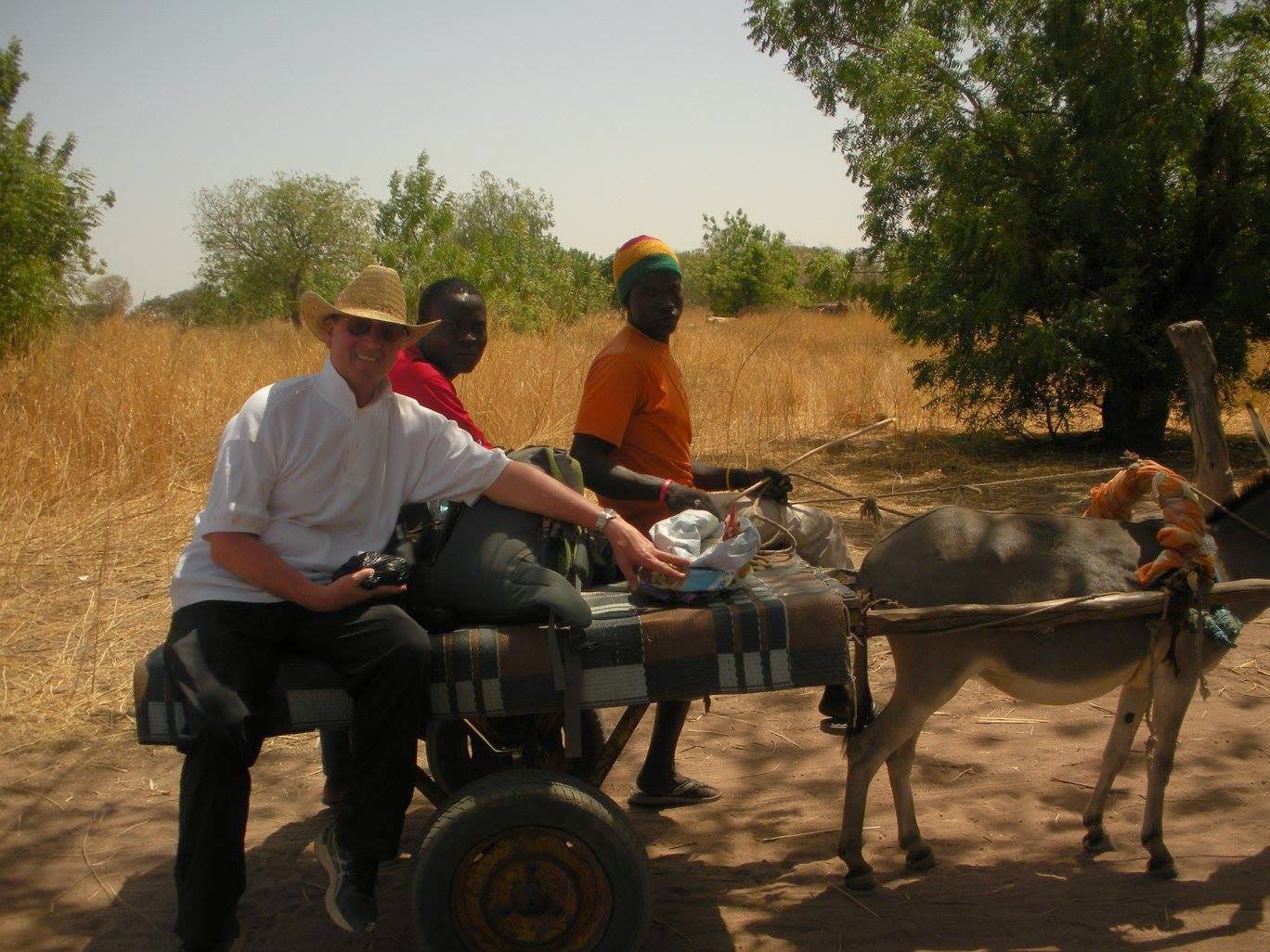
After playing hide-the-breakfast with the monkeys the next morning, we hitched a boat back to the main-land and sought out to buy—wait for it….a live chicken.  Gambian culture holds great importance on small tokens of appreciation.  Much like we would bring a nice desert or bottle of wine to a dinner party, we intended to bring a big fat chicken and some (rather elusive) carrots.  Also in tow were some cola nuts, a traditional symbol for thanks and welcoming, Dijon mustard, and some tea.  As you might imagine, even in my tour-guide, “I got this” mindset, I was flipping out about holding a live chicken for the 20 minute gele-gele and 15 minute bike ride into my village.  Thankfully, though, some friendly locals showed me how to tie up the bird in a plastic bag, and I proceeded to watch and pretend not to be horrified.  Sure, this is normal.  I have my bag of veggies, and also I have my bag of…live poultry. The ride proved cramped, but generally uneventful, and we soon arrived at Tim’s village, ready to grab bicycles and head off.  His most mom, however, insisted we hitch a ride on their neighbor’s donkey cart for the 3K into the bush.  We agreed. Here’s what ensued:
 
Try to envision my father and me-he in the Rodeo-regulation size hat, and me sporting a full Gambian two-piece complette, together with our new friend, Miss Chicken, all perched atop a wooden plank pulled along by an ill-tempered donkey.  The whole scene was hilarious, made even more so by the protest of both animals involved; Miss Chicken, sensing her fate was near, shared her rather spirited opinion on the matter by defecating and peeing all over my skirt (since she had, naturally, already torn through the plastic cage). The donkey, not wanting to be the only cooperating member of the bunch, joined in the fun by rearing up his hind legs to kick me in the hip every few minutes, which consequently scared Miss Chicken into again peeing herself, and thusly--myself.  Not long before this, I had felt compassion for this bird, having shrouded her in plastic during the heat of the day.  Concurrently, of course, I wanted to prevent her untimely death by dehydration prior to the proper slaughter, so I found it in me to actually bottle feed water to this feisty fowl.  This small kindness was promptly snuffed out, though, when the increasing stench and soiling of my dress allowed me to look very much forward to seeing Miss Chicken meet her end.  #sorrynotsorry


Looking a tad disheveled, we finally arrived.  My family was thrilled beyond all words to have my father as a guest, and he was given the red-carpet treatment. He sipped Attaya brewed with mint, helped me fetch water, and pounded up pepper and onion for (Miss) Chicken sauce.  Everyone ate from one big dish, Gambian-style, with our hands, and it was a really wonderful evening.  

After a night of sleeping in my backyard on a bamboo bed bought for the occasion, we woke to coffee and breakfast before my host father, having skipped worked to spent time together, took us around the village to share the cola nuts we had brought as an offering for the community.  This was really special as my dad was able to meet and see the faces and places that make up my daily life.  He was invited into their homes, tried his hand at a little local language (bless his heart) and got to hear how much everyone has enjoyed my presence in the village, which was really nice to hear when sometimes it can be so easy to be hard on yourself.  It was so nice to have both pieces of family together, and my heart was full and smiling that day.    

The smiles continued as my host mother, intent on showing her appreciation, knocked on my door later that afternoon.  I answered it to reveal Hawa, standing proudly, holding a dead chicken up to her grinning face.  It’s a rare occasion to have meat at all, and here we were having it two nights in a row! My host father said it best when he beamed, “Fatoumata, I will remember this day for all time.”  
My host father, Batchi Kandeh. "Take one with me and my animals!"
With many hugs and camera snaps, we bid our goodbyes the next morning, but not via the notorious ill-tempered donkey—this time we made off in style.  My neighbor drove us on his massive horse cart, a ride which provided both speed and scenic views, as a troop of baboons came right through my village as we drove off—a sight even I’ve never seen so close to home.  It was a lovely farewell to the bush, but it was time to kick it up a notch.  On the road awaited our private chariot, equipped with air-con and 4 wheel drive.  We loaded up and set off for our next stop, Baboon Island.  

Only about a two hour’s drive away, this hidden sanctuary houses four families of protected chimpanzees, an immeasurable number of bird species, and hundreds of monkeys and baboons.  We spent the afternoon on a small boat, riding the contours of the lush islands, watching as the chimps swung and crawled their way down the lowest branches to the banks, eager for their lunch to arrive.  Babies playfully jumped from one tree to another, while the most senior members just sunned themselves, flung over and slumped in massive heaps across fallen trees like heavy black coats over park benches.  Our boat captain kept a fair distance to ensure the safety of both species, which, while I suppose it did prevent the spread of communicable diseases and/or face-eating, it also unfortunately prevented me from getting a decent close-up of these magnificent creatures lazing about in the trees.  At night, we slept in safari tents atop high wooden structures over-looking the river, and the following morning, we took a guided walk to spot baboons, which kept a much closer eye on us than we did them.  All in all, while it was not the Gambia known to me, it is a small corner of the country holding a mystique all its own, and I am lucky to have seen it.  

Our chariot, having also slept at the camp, soon pulled up to begin the long drive back to the city.  For his last night in the country, our travel agent (cough, cough) highly recommended a stay at The Sheraton.  Not only is it close to the airport, it has real beds, hot showers, a spa, and mostly importantly, bacon.  Needless to say, it was the greatest taste of luxury I’d had in eight months, and while this may not have been the case for my dad, he nonetheless got a few laughs in as I brought life to the old adage, You can take the girl out of the village, but….(Smelled my newly pedicured feet in a public space, flooded the entire bathroom, ate like a heathen)  It wasn’t quite as pathetic a display as the guy from Encino Man, but it was sadly close enough to warrant comparison.

His flight was scheduled to leave just before midnight, so we had the whole day to relax, eat bacon, and play cards.  Around nine, our now familiar driver came to drag us from the Sheraton paradise and back to reality.  It was a teary goodbye, but as he left, I did manage to laugh as he willed to me none other than that monstrosity of a hat, which I then proceeded to wear, while simultaneously laughing and crying for a good deal of the drive back to the PC house.  I’m sure the driver enjoyed it.  #whitegirlcrazy

So it was that his visit ended as quickly as it came upon us, but what-a-week.  It is a rare itinerary which includes everything from beaches and baboons to killing your own dinner and carrying bath water on your head, but it captures the uniqueness of Gambia so perfectly.  It may not be for everyone, but I am so glad it was—at least briefly—for him.  Thanks, dad for the awesome visit.  I will remember those days for all time.  

Sunday, March 1, 2015

I'm Back! January/February Highlights 2015

As Christmas and New Years came to a close, January found me mostly at site, where as you already know, I have little access to electricity and even less access to the wonderful world wide web. So, regretfully, I wasn't able to post any blog updates. I will, however, try to give a brief update now and then I fully intend to get back on my monthly schedule.

First, sincere thanks to everyone who gave me birthday shout outs; although I didn't see them until fairly recently, it didn't make them any less appreciated.  Secondly, here is my best go at a quick yet thorough run down of the last two months.

5) Fatoumata Arti! 

After more than three weeks away from site, I finally returned on Saturday, January 3rd.  I enjoyed a quiet New Years with a few friends in Basse, but was ready to return to my hut and sleep through the night with no lights, snoring peoples, or any other lovely things that come with sleeping in an African frat house.   It's amazing how three weeks with worldly comforts so quickly became an overload to the senses.  I was craving the simplicity of my four crumbly walls and my bucket of water to bathe with under the moon.  Now, this is not to say I didn't appreciate the city life.  I did.  I wore jeans, I drank decent Cabernet, ate delicious meals, went dancing, drank much less decent Cabernet, and even treated myself to a one hour massage.  But, all that aside, I was ready for village.  I wanted to wear the exact same thing every day, and not brush my hair for an entire week without anyone plotting an intervention.

The journey home was long and tiresome, and the closer I got to my stop ,the more I found myself nervous about returning to village life.   Would I have to adjust to "going without" all over again? Would my family be happy to see me?  What if I forgot how to speak Pulaar?  Well, shit.  Maybe I'm not ready...?  However, ready or not, the bus stopped and I gathered my things and stepped down. After picking up my bike from Tim's house, I began my 15 minute ride into the bush of Sare Ngai.  I rode slowly, soaking up the last moments of alone time, going over phrases in Pulaar.
Toulie loving the camera

Soon, I arrived at the gate of my family's compound and shyly said, "Salaam-ma-lakuum". Immediately, my mom came bounding towards me, clapping her hands and stomping her feet.  She screamed, "Fatoumata arti! Fatoumata arti!" (Fatoumata's back!)  My little sister, Toulie, the toddler who had once been scared to death at the very sight of my face, came running up, smiling. She squealed, "Fatoumata!", which was the first time (to my knowledge) she actually spoke my name.  My heart melted.  I hugged Hawa, picked up Toulie, and all of the sudden, I was back.  The fears and hesitations I held onto about returning floated away when I realized that these people really had missed me.  I had become a part of something--a family, a village, a country--and it was slowly sinking in that this was all real.  I know I am not really named Fatoumata, and I'm conscious of the fact that these wonderful people are not my actual blood relatives, but here, where my sense of self, of "Meghan" is so distorted, I have, in a way, become Fatoumata.  She is real to all of the people I work with and befriend and spend time with.  She is real to the tiny little girl who falls asleep on my shoulder every night.  I just didn't realize until that moment when I pulled up on my bike that she is actually real to me, too.

4) Lettuce Eat

After eight months in-country, I've seen a few seasons of crops come and go.  There was the corn season, where the whole village smelled like smoke and charred popcorn. That was closely followed by watermelon season, where seeds and rinds littered the sand and my mouth was in a constant state of watering, and then groundnut season, where peanuts of every conceivable variety lined the streets of the markets.  But, January brought a new jewel to the market: romaine lettuce.  Please allow me to pause and soak in the pure joy that it brings me to even type these words.  Lettuce!  Something not only familiar...but something reasonably healthy...something crunchy...something fresh-tasting, green...something I can put balsamic vinegar on!

As you can see, I can't explain the excitement.  So, while I can't get my hands on these leafy beauties in my village, I can ride my bike 40 minutes to the big market on Saturdays.  At the end of the month, Tim and I had a movie-night pajama party, and in the morning, did just that.  I came home with the greatest jackpot I'd ever scored in the lumo.  We're talking a big cucumber, two carrots, a green pepper, onions, a few ripe tomatoes, and approximately 25 smallish bunches of lettuce.  (I may have gotten a bit overzealous...) After staying at Tim's for another three and a half hours getting my hair pulled into very intricate braids, I sped home to make a proper salad for my family to try (and to show off my new 'do, which, although it was startling at first, I now consider to be my prison-fab look).


I hurriedly chopped, peeled, and tore up the veggies. I whisked up my favorite dressing of dijon mustard, balsamic, and oregano.  So proud, I brought it out to my family and told them to enjoy this real "Italian salad". They put the bowl on the ground, squatted around it, and ate it with their hands.  I retreated into my hut, eager to whip up salmon-cakes using care-package ingredients to eat with my salad-- I was totally not sharing those. (Sorry folks...but thanks mom and dad!)  Once I had finished, I came back outside was thanked profusely my host father, who said he was so full, he didn't even care how fat he gets, let's eat it every day.  I explained that salad doesn't make you fat, that it fills you because of the fiber, and it's better for your body than medicine.  Everyone was shocked.  While we know these things instinctively, most Gambians don't have a clue about nutrition; they eat what's there and don't think about the value of it.  Rice and sugary tea keep you feeling full, so usually, that's all they have, completely unaware that the food they're ingesting has the nutritional value of a cotton ball.
 
The next morning, I sat reading with my coffee, and my mom called the family over for breakfast.  I cook for myself, so don't usually eat with them, but this time Hawa yelled in Pulaar, "Fatoumata, come.  We are eating the Italian medicines you like."  Sure enough, she had diced up a real salad at the demand of my father.  While she still fried onions and fish in oil and MSG, it was, nonetheless, a salad, and even the kids were eating it.  Now I don't know how long salad season will last, but that memory of seeing Hawa present her Italian-Gambia fusion will last a lifetime.

3) Houston, We Have Adjusted. 

The third week of January brought yet another splendid anniversary of my 26th birthday.  Being at site, I didn't do much, but I did manage to take a nice bike ride, have a few beers, and eat lunch by the river.  A week after that, my friend Jess, a fellow PCV, and Nora, her visitor from the U.S., came to stay with me for a day.  My family was thrilled to have not just one, but two strangers staying with us, and made sure to welcome them.  My mom gave me branches of dried leaves which I pounded and mixed with water to make henna, and we spent the first afternoon applying the paste to our feet in intricate patterns while neighbors watched and told us how beautiful our feet looked.  As the night rolled in, we sat and chatted around a fire and Nora seemed to enjoy the almost eerie quiet that comes with village life.
Freshly hennaed feet

Learning to carry things on my head!
The next morning, we took a gelle-gelle to Janjanburreh and stayed in a lodge for the night after lunching in a restaurant and watching a drum show at a local dive.  Having a visitor from America was incredibly refreshing, as it was the first time I'd experienced Gambia as a tourist. Things can get a little monotonous, so it was nice to re-see the little gems around me that I've started to take for granted.  The beauty of the sky, the graceful balance of the women carrying their plates and buckets atop their heads--it all reset in my mind how special this time is.

Getting used to fetching water everyday
Scout and I embracing local hair styles
Other things, however, were not so romantic. Jess and I were both confronted with the reality that our hygiene practices have been...reduced.  We no longer reach for the anti-bacterial every few minutes as we used to, we were okay with our level of smell if a quick underarm sniff only caused a slight up-turn of the nose, and wearing the same outfits three days in succession didn't seem socially unacceptable. We were also informed, with absolute authority, that our bodies have now adapted to the heat, and that bundling up in hoodies and blankets at night was in actuality, completely unnecessary.  These realizations, for better or for worse, showed me the changes both my mind and body have been going through these last eight months.  It's nice to see that I am adaptable, but I hope that I don't continue to "adjust" quite so steadily for the next eight, as I don't think I will be allowed on the plane back home if things keep up the way they've been going.


2) Weekend Warrior Two

I wrote back in October about attending a yoga retreat at a lodge up country.  At the end of January, I had the opportunity to attend another one, only this time there was a change of venue.  About 22 of us hauled ourselves, mats in tow, to an EcoLodge in the Western coastal region of Kartong.  The resort, named Sandele, for "now, be still" in the local language of Mandinka, was the perfect place to escape village life and have a weekend of relaxation.  These retreats are meant to serve as a time to escape back into our American skins-no children, no translation, no constant attention for being different. We ate vegetables-amazing!, used composting toilets-not so amazing, but definitely cool, and took showers with running water heated from solar panels and pumped by wind turbines.  I taught a kickboxing class, rose early for sunrise yoga, and of course, sat by the ocean. At night, we had a story slam on the beach complete with a bonfire, where we got to know some of the newer people who have recently arrived in-country.  It was awesome, and for about 48 hours, I barely remembered that I was in the Peace Corps at all.

1) Scripture Staycation!

Well, clearly I have saved the best news for last! However, in lieu of a full spoiler, I will be saving some of the goodies for a later date, as I have no pictures yet for all the stories, and my mother will die if I post details to the internet without her hearing about them first-hand.  The last week of February brought a very exciting visitor to The Gambia...my dad!

After working almost the whole month going back and forth to workshops on malaria prevention, gender equality, and literacy, I excitedly made my way to Kombo to pick up my father from the airport in Banjul on February 21st.  I was so pumped and had a whole week of things planned out for us.  We spent two days in Kombo, talking, sight-seeing, marketing, eating, and boating.  He was able to see my village, sleep in my little hut, and get to know my family away from family, which was so special.  The last few days were spent touring around some parts of the country that my meager PC earnings don't allow for without a little father funding, and then yesterday, I reluctantly rode with him to the airport so he could begin his 24 hour journey back to Cleveland.   I can't wait to get some pictures up and share some of the highlights, but it will have to wait until I have all the camera charging, USB-ing, and uploading tools. Until then, I hope everyone is surviving the cold back at home.  Thoughts and hugs to all of you, and I promise to write and post pictures soon!


Thursday, January 1, 2015

Top 10 Gambian Tidbits and Honorable Mentions: 2014

I am officially at the sixth month mark in my service.  Throughout this time, I have learned a lot, made countless memories, and sweat through every single item of clothing in my possession.  While I have shared many of these moments with you, there are some more random stragglers that don't necessarily require a lengthy explanation, but are nonetheless telling about the culture I am currently nestled in.  They may not be funny, they may not seem noteworthy at all, but they are my little gems, my bits of life that have kept me going so far.  I hope that 2015 brings a thousand more.  Merry Christmas and Happy New Year to all you wonderful people.


10) Jifffy Lube

Desperately lacking in protein, Gambian cuisine depends heavily on the nutrients provided by groundnuts. They roast them, pound them into dusty flours, grind them into peanut butter for sauces poured over rice, and, during periods of abundance, simply boil them for snacks. If you can find a way to eat them, they are generally interested. The only exception to this rule, however, seems to be the way in which one should consume peanut butter. In my opinion, it doesn't take much to make eating peanut butter an enjoyable experience, as I am of the camp that believes a spoon alone provides a sufficient vehicle for getting this sticky goo into my mouth. I now know that Gambians wholeheartedly disagree.

I have learned a lot about making all products peanut in the last few months. From picking and shelling to roasting and grinding, I've done it all. Making my own peanut butter from nuts that I actually plucked from the ground was one of my crowning moments. I even got a small cheer of approval from my family, who had been so eager to teach me all about this tasty paste; but, they were also curious to see what I was going to do with it once I made it. I don't eat the rice, so I don't need sauce for it...They just couldn't imagine what the hell I would do with it. When explaining to my sister about my philosophy on peanut butter, she was horrified. What do you mean eat it plain? Just only this? And, when I further explained that Americans also like to eat it on bananas, apples, or on bread, she was absolutely disgusted. She laughed, turned and said something to her friend, then looked at me a little bewildered, and said, “An ko psy psy” which literally means, “you're crazy.” #moreforme

9) Tailor Trouble

As Gambian weather is harsh on clothes, most American things I brought have already bit the dust—chewed it up, and then violently regurgitated it into stained shreds off cotton-poly blends. So, I've had to branch out and get some clothes made. This can create stress as it is very hard to find someone who can sew clothes in a subdued Western style. Gambian women wear these elaborate shirt-skirt combos called complettes. They are covered in ruffles, metallic sparkling ribbons, and the tailors here just cannot help but to add these lovely touches to everything they get their hands on.
One of my brothers, Gibi,is a tailor, and after a couple of epic failures, I decided to try a new guy in Tim's village up the road. That turned out alright, but it took three exhausting tries to get things in wearable condition, and I felt so absurdly guilty for “cheating” on my brother that I found myself lying when asked about my new clothes, awkwardly explaining how a friend had given them to me.

Last week, I decided to attempt get some Christmas fashions made, so I hauled out to yet another tailor further down the road. Now I was cheating on my guy on the side-suddenly transformed into a big fat cheater complete with irrational lying and hiding pieces of fabric in black plastic bags as I passed his shop so as not to be found out. For days, an internal dilemma took over. Should I only wear certain things in the presence of the creator of the outfit? No, that could be stressful. Maybe I should just come clean and admit to my inability to commit. No, I would hurt their feelings. Well, turns out, the joke's on me. The newest “suitor” is apparently my mom's brother-in-law and word is very much out that I've been getting clothes made all over town. Initially, I was mortified, but now I feel free to wear any random getup I please without the fear of being called out on my infidelity. 


8) You Missed a Spot

       I often mention how hard Gambian women work in order to keep their households running. One thing in particular that has always struck me as unique is the sweeping of the compound. As most time is spent outdoors, the area outside the huts is the place that looks the most “lived in” at day's end. There is no den or family room, but there is a a front yard with some plastic chairs and a fire. Biscuit wrappers, flip flops, random peanut shells, bits of charcoal, and hundreds of tiny footprints from the naked feet of playful children litter the sand. So, as strange as it may seem, the women take to sweeping the sand with these short brooms made of sticks. They brush the sand back and forth into very intricate wave patterns. The first time I witnessed this, I remember thinking, What the hell? Who sweeps sand?”, but now, when I come out of my hut in the morning, I really appreciate the tidy look of the compound; the lines in the dirt are every bit as orderly and pleasing to the eye as lines in freshly vacuumed carpet, and these days I just sweep the sand with the best of them.

7) Sugar Daddy

Like many Americans, one of the most crucial steps in my morning routine is drinking a cup of hot strong coffee. Milk or no milk, hot as can be, and definitely no sweetener. There's nothing like it. Gambians drink something called Attaya, which is a very strong tea brewed with equal parts sugar and water. Sugar is taken very seriously around here as Gambians on the whole, feel that there's nothing that cannot be improved upon with the addition of obscenely large doses of this white grainy drug.

One morning, I was sitting outside enjoying some coffee, when my host father asked if he could try some. I warned him that Gambians tend to hate American coffee, but he insisted. Eager to see his reaction, I gave him the cup and watched as he slowly brought it to his mouth and took in the smell, unknowingly imitating a Folger's commercial. But then, after taking a small sip, his face turned sour as his body immediately rejected the bitter beverage. Panicking, he shoved the mug back at me and yelled in Pulaar for the teenage boys brewing Attaya to bring him sugar with precisely the same urgency as a surgeon calling for a scalpel. The boy rushed it over, my host dad dumped
approximately a quarter cup of it into his hand, and began to tongue clumps of it from his palm. Sufficiently leveled out, he looked at me, pointed in my face and said sternly in English, “How you can drink this, Fatoumata? Why did you give me this?,” and promptly got up and walked away...presumably to find more sugar.

6) The Elephant in the Womb

     Within The Gambia, there are several different ethnic groups, each with their own customs and language. As I've mentioned, I am living as part of the Fula tribe, who are known among other things like cattle and nice fabrics, for their strange superstitions. They are convinced that the spit of salamanders will burn your skin, that falling stars mean the devil is on the hunt for a kill, and they believe that if you admit that you are with child, that baby will not make it into this world. Now, with no cable, restaurants, or other worldly distractions, a fair amount of mating is going on. Women are pregnant all over the place. But, unlike most of the world-there are no questions asked, no bellies rubbed. They simply go about their chores pretending as if they've just suddenly gained a good deal of weight.

Recently, my host father warned me to expect a baby to be born in our compound this coming spring. It's very unusual for him to have told me, but said he “knows how the foreigners like to make plans about all the things” which I thought was hilarious, endearing and also fairly accurate. So, Hawa is having a baby. I cannot, of course, let her know that I know, so I will continue on pretending that she is just very much enjoying groundnut season until I suddenly have a brand new baby sister or brother to hold come April-ish.

5) The Pork Palace and the Drunkard's Den

Because Gambia is a predominantly Muslim country, two of life's greatest offerings are strictly prohibited: pork and alcohol of any kind. This creates a problem for us foreigners who walk around craving crisp bacon and cold beer. True, we manage to get our fixes of adult beverages from time to time, but pork cravings are those satiated only in the big city of Kombo—or so we thought.

Last Saturday, Tim and I rode our bikes to the large outdoor market for some wandering and shopping. As the sun came out, our mouths began watering for an ice cold beer. A fellow Peace Corps friend there with us helped out by calling a Christian Gambian who knew a guy who knew a guy. Turned out that guy was a gal and her name is Fatou; she apparently runs a little hush-hush operation in a small area of her back yard. It's a tiny shack fenced in by corn husks and has a cooler, two benches, and an array of bottom-shelf liquors guaranteed to provide the most miserable of hangovers. The other side of the “bar” serves as a slaughter-room slash kitchen for all things pig. Jackpot.

We followed the confusing directions, trying to think positively and not be too disturbed by the fact that this place was in the lady's yard. Lost, we called her, she kindly came out to the road and waved us down, and soon we were escorted inside. Taking our seats on the wobbly benches, we exchanged comforting safety in numbers glances, and ordered our beers. Fatou passed them around, while simultaneously breast-feeding her child. We figured if the beer was cold, we'd stick around and maybe ask about the pork situation. This was potentially the best Saturday ever. Sadly, this did not come to be. Although the beer was tasty, the other patrons at this establishment were (shockingly) not of the highest caliber, and we felt it best to high-tail it out of there before a few overly-friendly thigh slaps and an inappropriate pinch of the rear turned into unmanageable circumstances. It's an unfortunate consequence of a mostly dry country that these problems are not uncommon; those who imbibe and the places that cater to them are not always the classiest. From here on out, I will just accept that pork is just not happening up-country, and I promise to refrain from imbibing in the backyards of strangers.

4) I see London, I see France, I see Hawa's....Kneecaps

      Another component of Muslim culture is the necessity for modesty in public. This is especially applicable to women—no skirt or dress should be at or above the knees. Aside from random glimpses pumping at the well or washing clothes, it's very rare to see the legs of any woman. Late in October, I accompanied Hawa to the peanut farm to check on and pull up a few plants. The grounds surrounding the farm are littered with bushes that have those sharp prickly balls that stick on your clothes and later stab into your skin like tiny knives. So, before entering, Hawa stopped, looked around, and, feeling that we were out of site, tied her long wrap skirt up around the tops of her thighs. She motioned for me to do the same and we proceeded into the fields. She and I walked along, picking up bunches of groundnuts, and munching through the soft shells to get to the earthy, radish-like flesh. She found some sticks good for chewing (the surprisingly effective method of dental hygiene here) and then found some nice green leaves to pick for folaray, a leaf sauce eaten over rice. Having forgotten a bowl, Hawa unraveled part of her black head wrap and used the end of it to tie up the leaves, giving the illusion that she had long black hair.

Paired with her skirt hiked up, I saw my host mother in a totally new light; for this short time, she wasn't some middle-aged Muslim woman with four children, she was a young girl walking through a field picking flowers. She smiled knowingly as if to say that's also how she felt, and we shared a moment where we—without words—bonded as women. Baring our knees opened the gate to bare our girlishness, and it was a special exchange. It's so easy to look at the women around me, covered head to toe in yards of fabric, and see nothing more than that, but seeing Hawa in the farm that day opened my eyes to the reality that she is just like me....only with much longer legs.


3) Ba, Ba, Black Sheep, Have You Any Soul?

Back in October, I wrote about the slaughtering of the rams to celebrate the holiday of Tobaski. As the months roll by, the price for these animals rises exponentially, so it's good business sense to try and buy one early and care for it throughout the year. Our family lucked out as our female sheep was pregnant and due any day. I was getting ready for school when I heard an oddly pained cry. I came out to see the smallest little sheep you ever saw, covered in substances that clearly explained the weird cries. But oddly, the mother sheep was nowhere to be seen. I asked what was happening, where was she? My sister, Kadjiatou, explained that seconds after giving birth, the mother attempted murder by head-butting and then ran away to find food. I was torn—I felt awful for the little guy, but I wasn't about to cradle his gooey body and play mommy. I also felt a tinge of guilt as I identified with the mom; her instincts, or lack thereof, are precisely what terrifies me about having a baby of my own. No, I wouldn't try to murder it...at least not right out of the gate, but would I too lack that motherly instinct to feed, hold and even love my child? It's a scary thought, but something I ponder more and more as the anniversaries of my 26th birthday continue to accumulate without any prospect of procreation.

As for the sheep? Sadly, the baby passed away after two days of attempted mothering by my brother, and the mom seems content...unaware or unconcerned about her missing offspring. As for me? It remains to be seen, I guess, but lately I've taken to letting the sheep graze in my yard instead of shooing her away. I figure, it's Christmas, and we cranky ole biddies may as well stick together.

2) Walking in Fields of Grain

Since the moment I arrived in my village, my host father has talked about when I would accompany his sister and spend the entire day working alongside the other women in the rice fields. It was one of those things I wanted to do, but was more looking forward to the memory of having done it than the actual experience itself. I've never worked in rice fields, but everyone in the village had been warning me how difficult it would be, how my whole body will pain me, and that I should wear long sleeves so I don't bleed as much. Great. So, as you can imagine, I was very intimidated and mildly frightened as the day approached. Sunday morning came, and I prepared my things: enough water to get through the day (as I cannot yet drink water from random wells without undesirable consequences), a long sleeve shirt with a collar I borrowed from a neighbor, and a tikka, or head-wrap to protect my hair from the prickly stems of the rice.

We set out on a horse cart; ten women and two men making our way through village after village until we reached the river, where the rice fields of all surrounding villages are located. We were followed by a donkey cart, carrying a few other people and some supplies. The drivers and women joked back and forth about how we were better than the donkey cart people (because horses are faster) and the donkey cart folk retorted that actually, our horse should be put to death because the donkey was keeping pace with the him and therefore bringing shame to all horses. It was all very amusing. The rest of the day, however, was devoid of humor. It was time to work.

Upon arriving, we unloaded the gear, took off our flip flops, and plotted out a route from the generator-run grain separator to the rice field, where stacks of massive stalks lay ready to be hauled over the land and piled for grinding. The women showed me what to do. Basically, you bend down at the waist, scoop up an enormous amount of stalks, each easily exceeding eight feet in length, hoist them up and onto your head and walk the through the gushy wet field about 200 yards. After the initial hilarity of white girl carrying rice on her head wore off, we had a beautiful, albeit exhausting day. We walked for hours and hours, back and forth without much talking, but there was a lot more to soak up than just words. The fields were home to hundreds of the most beautiful birds, cranes, and a troop of baboons playing on a nearby tree, and the sun was strong but hidden enough behind clouds that it sent beams of light onto the tall stalks of grain. The wind blew lightly, creating a soothing whooshing sound, and the absolute blackness of the women's skin was so gorgeous against the bright greens and yellows of the grasses that I even thought for a moment that I would come and work again the next day just to have the chance to capture them with my camera. While I did not make it out, I do plan to revisit this serene place that seems to be a separate Gambia-a world starkly contrasting to the loud bustle of markets, villages filled with a hundred noisy children, or the cramped buses I so often find myself in.

1) Food Items, the People Who Serve Them, and Also Christmas

Beginning December 11th, my entire group took off for Kombo to attend the swearing-in ceremony for the new agriculture and health volunteers (AKA, eat things involving cheese and drink lots of low-quality alcoholic beverages.) After the weekend, the education group had a week of classes at the Peace Corps office reviewing how our service is going so far, and learning more about how to get involved. Every night, dinner was on our own, so we missioned out to restaurants looking for all the food stuffs we'd been craving. While the food was usually great, the ordering part of the program proved the most difficult. Waitresses here are not like those at home. They're not working for tips, so speed isn't much of an issue, they usually don't know much about the menu, and sometimes, they may not be aware that you even want to order food at all, since sometimes people just come to take a load off and sit at a table. This sounds like a first-world problem rant, and perhaps it is in part, but it is amusing enough that I find it worth sharing.

Going out to dinner is not really a Gambian thing, so they are mostly catering to either the very wealthy or foreigners. My friend, Scout has a story that puts things into perspective. Upon looking at the menu, she saw something under the sandwich section, but had a question for the waitress. She asked “What is the Philadelphia?” to which the woman responded, “It's a food item.” Ahhh...now we understood. Not. Needing further detail, she got more specific. “What's on this food item?” The waitress explained, “Hmm..Philadelphia”. Perfect. Not in the mood for a eating a metropolis, Scout decided to order the vegetarian pizza.

Scout: “What comes on the vegetarian pizza?”

Waitress: ”Everything.”

Scout: ”Everything? Everything comes on the pizza?”

Waitress: ”Yes.”

Scout: ”Yea, ok, I'll have that.”


Needless to say, while Kombo at Christmas was fully enjoyable with all it's offerings and worldly fare, it became more enjoyable to buy groceries and cook at the Peace Corps house than attempt to play Who's on First with the employees of the local eateries. Christmas morning, a group of about 30 of us enjoyed home-cooked dishes, wore festive clothes, and even had a white elephant gift exchange. It was a nice holiday, but now as the year is at a close, I find myself more ready than I ever expected to return to the quiet life of my village and sleep alone in my hut. With that, I am heading home tomorrow, returning to the land of the disconnected and wi-fi-less. Here's to wishing that 2015 brings even more crazy memories and experiences for all of us.